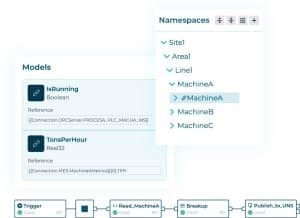


Build a strong data foundation for Industrial AI
Industrial AI is fundamentally transforming how manufacturers and industrial companies plan, produce, and optimize. It unlocks new opportunities for efficiency, automation, and transparency across the entire value chain.
However, without the right data infrastructure, AI initiatives remain slow, costly, and difficult to scale sustainably.
To successfully implement Industrial AI, companies need modern tools and practices that bring IT and OT together and make everyday challenges easier to manage. Organizations that want to move quickly establish Industrial DataOps as a core discipline.
As AI technologies continue to evolve rapidly, HighByte and Novotek combine deep industrial data expertise with a strong partner ecosystem to deliver solutions that make Industrial AI practical and scalable.
Industrial AI at a glance
Industrial AI can be grouped into three main categories:
| Agentic AI | Generative AI | Traditional AI / ML | |
|---|---|---|---|
| Primary Function | Goal-driven actions and decision-making | Content creation (text, code, images) | Automation of repetitive tasks and pattern recognition |
| Autonomy | High, minimal human oversight | Variable, depends on user prompts | Low, rule-based |
| Learning Approach | Reinforcement through experience | Based on existing data | Based on rules and human-defined behavior |
| Use Cases | Asset maintenance, inventory, line performance | Quality inspection, automated OT tag mapping | Cloud-based predictive maintenance, anomaly detection |
Industrial AI and DataOps – working together
AI for DataOps
AI enhances the efficiency and scalability of DataOps by automating data ingestion, contextualization, and transformation, enabling faster access to reliable insights.
DataOps for Industrial AI
DataOps is the foundation of Industrial AI. It structures and validates data from heterogeneous sources, creating the conditions for stable and scalable AI deployments.
Industrial Data is (often) not AI-ready
The performance of Industrial AI models depends directly on the quality of the underlying data. In industrial environments, this data comes from a wide range of sources and formats.
To reliably support AI, data must be complete, accurate, and properly prepared.
Key factors for AI-ready data:
- Accessibility: Do you have easy access to all relevant data (MES, OPC, MQTT, data lakes, machines, sensors, etc.)?
- Completeness: Are your datasets complete and validated?
- Standardization: Can your data formats be aligned to a common standard?
- Contextualization: Is your data enriched with meaningful context—from the edge all the way to consuming systems?
What is a Unified Namespace (UNS)?
- What is a Unified Namespace?
- What are the benefits of a UNS?
- How does it differ from traditional industrial architectures?
How to build an Industrial AI strategy
- Assess your current maturity (culture, processes, technologies)
- Build a cross-functional team across sites and departments
- Identify high-impact use cases with quick wins
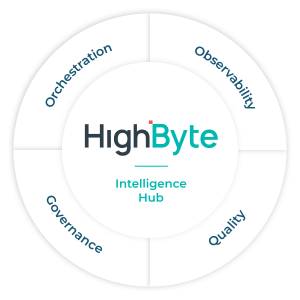
- Establish a robust data foundation (quality, governance, orchestration, monitoring)
- Select the right, secure, and reliable Industrial AI tools
- Experiment and iterate: test, measure, and continuously improve
Industrial AI + HighByte Intelligence Hub: Product Demonstrations
Automated OPC integration
Automatically generate and apply data models to simplify tag mapping using generative AI.
Industrial MCP server
Expose your data pipelines via the MCP protocol as tools for agentic AI—making it easier to integrate Industrial AI into your operations.
The original version of this page was created by HighByte and is republished and translated here with permission. You can read the English original on the HighByte website.
Understanding DataOps: What it is and why it has become indispensable
How to kick off your DataOps journey? Download the 10-step guide.