




Integration & Orchestration: Seamless data flows across all systems
Connect your systems, automate data flows, and build the foundation for efficient, transparent, and flexible production from the shop floor to the cloud.
Ask an Expert
Why Integration & Orchestration matter today
Modern industrial and manufacturing environments generate vast amounts of data. Sensors, machines, control systems, MES platforms, ERP solutions, and cloud applications continuously produce data in a wide range of formats and protocols. Simply collecting this data is not enough. The real value lies in connecting, orchestrating, and making it usable. Only then can organizations truly manage and optimize their production in a data-driven way.
Integration ensures that data is accessible and technically connected across systems.
Orchestration ensures that this data is automatically processed, intelligently managed, and delivered in the right context, exactly when and where it is needed.
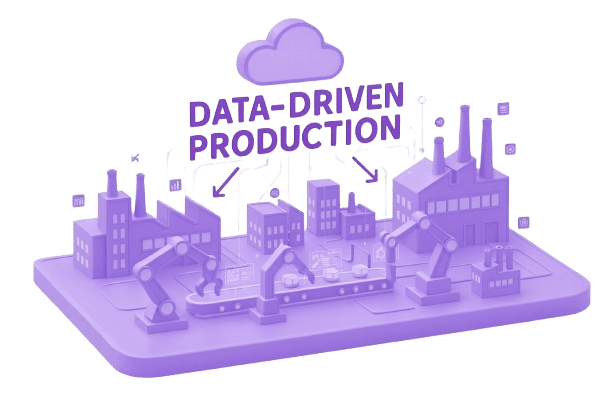
What does Integration & Orchestration mean in an industrial context?
INTEGRATION
Integration goes beyond simply creating data interfaces. It enables the seamless connection of heterogeneous systems across the entire industrial landscape:
- Machines, sensors, and PLCs
- SCADA, MES, and historians
- ERP systems, BI tools, and AI/ML platforms
This creates a robust technical foundation where all relevant data can flow freely—eliminating data silos and disconnected systems.
ORCHESTRATION
Orchestration takes this a step further. It refers to the controlled and automated flow of data across systems, including rules, workflows, timing, and dependencies:
- Automated processing of data events
- Data transformation and enrichment
- Delivery of data for analytics, dashboards, or control logic
- Monitoring, error handling, and governance
In practice, this means data is not just collected, but delivered in the right format, at the right time, and in the right context. This becomes a key enabler for data-driven decision-making and automated industrial processes.
In traditional industrial environments, a mix of control and IT systems often operate in isolation. This leads to data silos that are difficult, if not impossible, to integrate into end-to-end processes. Without reliable integration and intelligent orchestration, data handling remains fragmented, error-prone, and reactive—the exact opposite of a data-driven production approach.
Integration acts as the technical bridge. Orchestration defines the rules for data flows determining when, how, and where data is transported, transformed, and enriched. Orchestrated schedules or event-based triggers, automated transformation logic, and dependencies between data streams ensure that raw data is turned into meaningful information. And that delivered in real time to decision-makers, AI models, automation scripts, or dashboards.
The result: production processes become more transparent, faster, and more resilient. Downtime is reduced, optimization potential increases, and decisions are based on data rather than intuition—a critical advantage in the era of Industry 4.0.
How does this relate to data-driven production?
Data-driven production describes an approach where decisions and optimizations are based on real-time data. Instead of relying on static reports, intuition, or delayed analysis, production is managed in a dynamic, transparent, and process-oriented way through:
- Real-time visibility of all relevant data
- Automated analytics and AI-driven predictions
- Intelligent control instead of manual intervention
- Powerful workflows across OT and IT systems
In this context, data integration is no longer just a technical task. It becomes the operational foundation for efficiency, flexibility, and competitive advantage.
Tangible benefits for your business
CHALLENGES
Company
Data silos and redundant systems
Manual data preparation
Delayed decision-making
High maintenance effort
Heterogeneous system landscapes
SOLUTION
Integration & Orchestration
Centralized connectivity across all data sources
Automated workflows and data transformation
Real-time data delivery for analytics
Standardized, reusable data pipelines
Consistent processes across systems

The strategic link to your data architecture
Industrial DataOps
Industrial DataOps is an organizational and technical framework that automates data pipelines, ensures data quality, defines responsibilities, and treats data as a product. It provides an overarching approach that structures and governs how data is managed across the organization.
Within this framework, Integration & Orchestration act as the operational layer. They enable the practical implementation of DataOps principles by automating workflows, ensuring consistency, and enabling seamless collaboration across systems and teams.
Unified Namespace (UNS)
A Unified Namespace (UNS) creates a centralized and consistent data structure where all relevant production and business data is available in real time, as a single source of truth. While the UNS provides the architectural foundation, Integration & Orchestration enable the dynamic flow of data. They ensure that data is continuously integrated, processed, and delivered to support processes, analytics, and automation.
Together, UNS, Integration & Orchestration, and Industrial DataOps form a modern data architecture paradigm enabling connected, scalable, and truly data-driven production.