




Unified Namespace:
Structure instead of point-to-point interfaces
Today, production data flows through countless point-to-point interfaces. As new systems are added, complexity continues to grow. A Unified Namespace changes this: it organizes data and creates a scalable foundation for AI, automation, and real-time visibility.
Ask an Expert
Complexity comes from unstructured connections

Multiple point-to-point integrations create a tangled data landscape

Systems become interdependent, slowing down change

New applications or AI projects are difficult to scale
In established production environments, new interfaces are added continuously. While each integration solves a specific problem, it also increases structural complexity.
Point-to-point connections create dependencies, make changes more difficult, and limit scalability.
The result:
- Data exists, but is not consistently organized
- Information is available, but not universally accessible
- Changes and updates require increasing effort over time
To overcome this, a different approach is needed.
A Unified Namespace is not another integration, it is a structural alternative.
What is a Unified Namespace?
From point-to-point to a structured data layer
A Unified Namespace organizes industrial data from multiple sources into a consistent, shared structure.
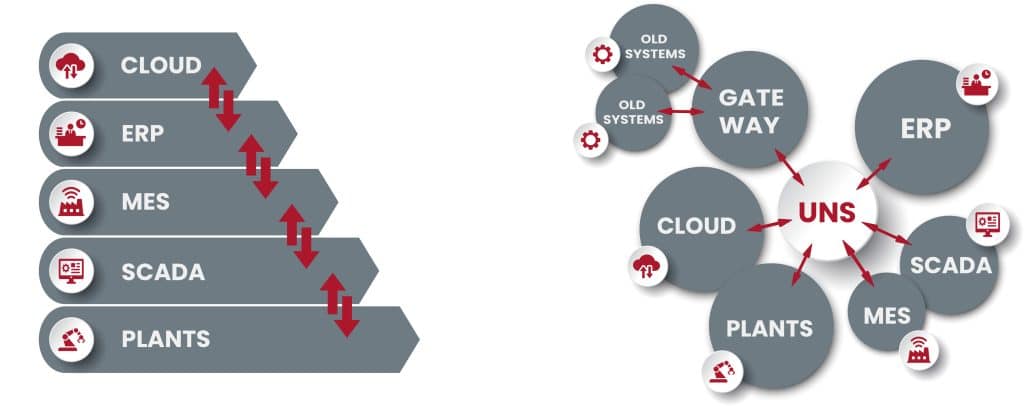
Classical architecture vs. Unified Namespace (Hub-and-Spoke)
Instead of exchanging data directly between systems, all information flows into a shared structure. This allows systems to access the same data foundation, regardless of source or technology. The benefit: a single, consistent, real-time view of assets and production processes.

Not a product – a principle
The architecture principle
A UNS defines how industrial data is structured, named, and made accessible. By doing so, it creates a shared data layer and reduces direct dependencies between systems.
Key outcomes:
- A centralized and consistent data structure
- Standardized naming and contextualization
- System-wide access to reliable data
How a Unified Namespace is built
You build a Unified Namespace by integrating and structuring data across multiple layers.
In practice, this involves:
- Provide
Make data centrally available in real time - Connect
Capture data from machines, controllers, and IT systems - Structure
Organize data into a unified format - Model
Define context and meaning for all data
UNS in Daily Production
Typical Use Cases
A structured data foundation enables a wide range of applications in production.
- Real-time visibility of production status
- A reliable foundation for analytics and reporting
- Data provision for AI and advanced applications
Maximizing value from a Unified Namespace
A Unified Namespace does not only improve data access, it fundamentally changes how production, IT, and management work with data.

Production
- Reduced downtime
- Faster decision-making
- Less manual effort
IT
- Lower integration effort
- Clean data architecture
- Standardized structure
Management
- Scalability for AI initiatives
- Reduced total cost of ownership
- Platform strategy instead of point solutions
The strategic link to your data architecture
Integration & Orchestration
Integration & orchestration ensure that data reliably enters the Unified Namespace and is efficiently processed from there. They connect heterogeneous systems, transform data, and manage automated data flows across layers. Result: The UNS becomes not only a central data platform but also an active hub for processes, analytics, and applications.
Industrial DataOps
Industrial DataOps adds a methodological and organizational layer. It defines how data pipelines are built, monitored, and continuously improved—with a focus on automation, data quality, and collaboration between IT and OT. Without DataOps, a Unified Namespace may function technically—but scaling and consistency remain challenging.