

i3X explained: The new API layer for industrial data access
Industrial digitalization is advancing faster than ever—yet one key challenge remains: accessing data is often complex and far from standardized. Each platform comes with its own API, making integrations time-consuming and difficult to scale. This is exactly where i3X comes in.
In this insight
What is i3X?
i3X stands for Industrial Interoperability eXchange. It is an open, vendor-neutral API framework developed by CESMII, the U.S. institute for Smart Manufacturing.
The goal of i3X is to establish a common API for contextualized production data. This allows applications to interact with industrial systems—such as historian databases or MES systems—through a single, standardized model instead of multiple proprietary interfaces.
i3X is currently in a pre-release alpha stage, with a full version 1.0 expected in 2026.
How does i3X work?
i3X is not a protocol—it is an API specification that standardizes how data is queried. Until now, there has been no common interface for querying data, accessing historical values, or managing relationships across systems.
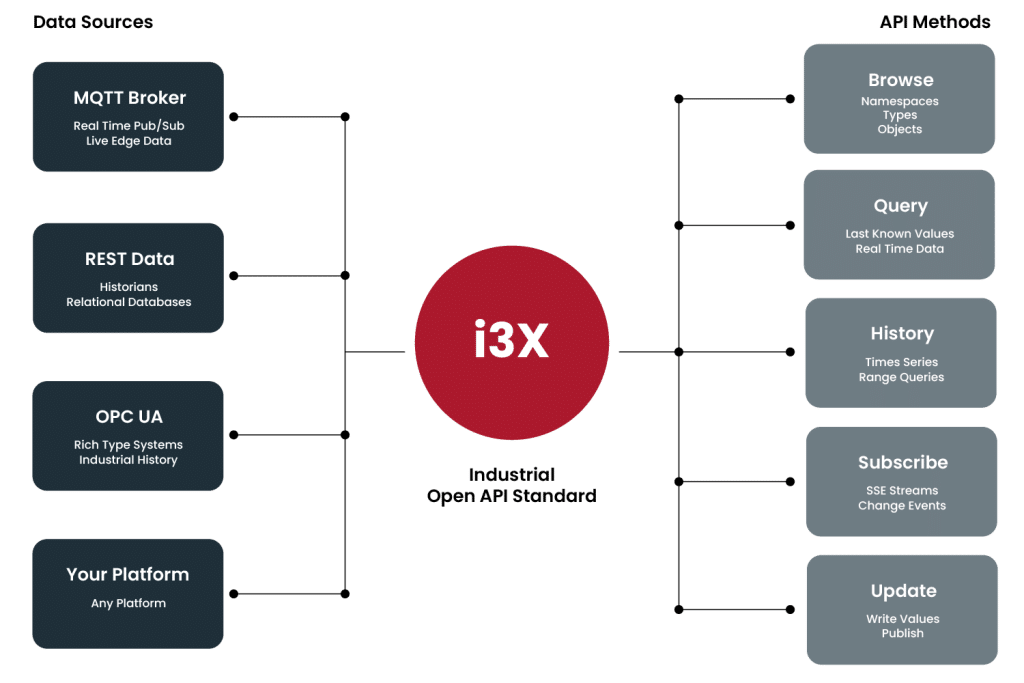
i3X introduces a unified API layer between data platforms and applications. This allows all systems to expose data in the same way—regardless of vendor, format, or technology.
- Subscribers
- Object types
- Relationships
- Historical data
- Real-time values
What challenges does i3X solve?
OT environments often struggle with integration challenges due to proprietary APIs. Each platform and application requires its own custom configuration. With five platforms and five IT systems, you quickly end up with 25 individual integrations, before gaining any meaningful insight into production data.
In recent years, the Unified Namespace (UNS) has addressed similar challenges for event-driven data flows (pub/sub). However, a standardized interface for querying contextualized data has been missing—until now.
i3X is designed to close this gap.
Practical use cases
i3X provides a unified interface, allowing integrations to be built once and reused across systems. This is particularly valuable in environments where multiple platforms need to communicate simultaneously.
For example, when an application requires data from a historian, an MES system, a UNS, and a quality system, i3X enables access through a single API, eliminating the need to manage multiple interfaces.
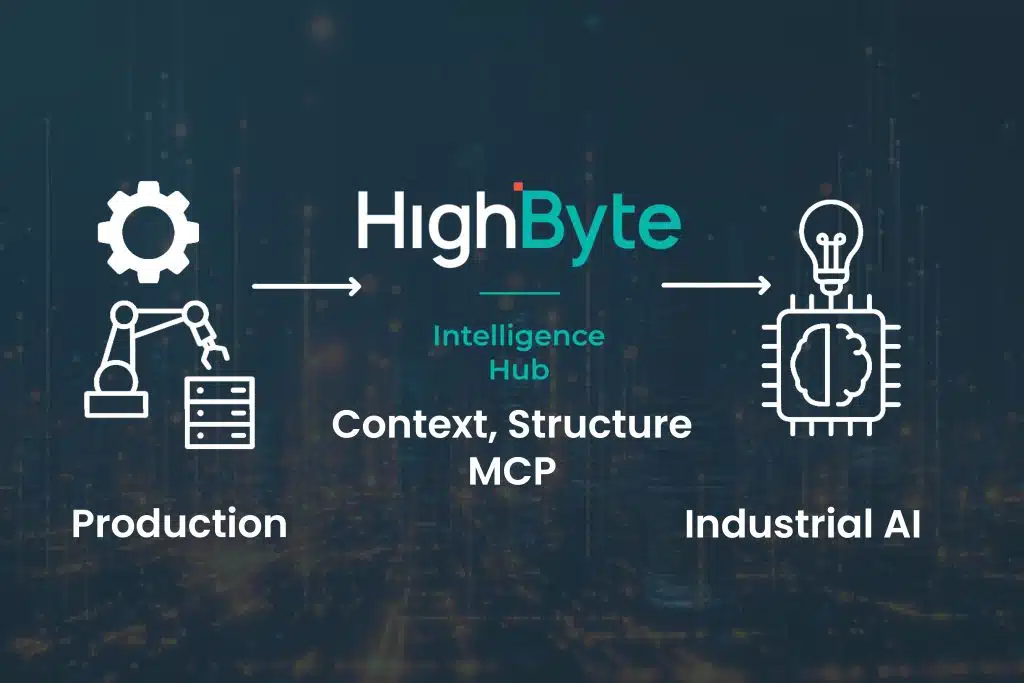
i3X is also highly relevant for AI systems, which depend on fast access to structured and contextualized data. HighByte Intelligence Hub.
i3X and Industrial AI / MCP
AI systems don’t just need data—they need to understand it. This is a major challenge, especially for agent-based industrial AI. The Model Context Protocol (MCP) defines how AI agents connect to data systems, but it does not define what objects, relationships, or data types exist.
i3X fills this gap by providing a standardized API with structured data. Combined with MCP, it enables AI agents to find, understand, and use industrial data more efficiently, while reducing development effort and complexity.
How does i3X compare to other technologies?
To better understand where i3X fits, it helps to compare it with two well-known technologies: UNS and OPC UA.
i3X vs UNS
A Unified Namespace (UNS) enables real-time event streaming using pub/sub communication such as MQTT. It is ideal for real-time process data and event-driven architectures. i3X serves a different purpose: it provides a standardized API for accessing structured data.
Together, they enable both real-time data flow and standardized access to historical data, objects, and relationships.
i3X vs OPC UA
OPC UA is a communication protocol used to collect data directly from machines. i3X operates at a higher architectural level. It standardizes how applications query contextualized data from platforms such as historians, MES systems or a UNS.
The two technologies serve different purposes and can be used together, for example through a future OPC UA-to-i3X bridge.
What does i3X mean for the future of industry?
i3X has the potential to become a foundational layer for the next generation of interoperability. However, it is still in an early stage and has not yet seen widespread industry adoption.
CESMII and ARC Advisory Group consider i3X a potential key enabler for industrial AI, as it standardizes the semantic layer—the “language” AI agents need to understand data across systems.
Challenges and Risks
Despite its strong potential, i3X also comes with challenges. The most significant is that it is still in an alpha stage and may evolve before reaching version 1.0. Early implementations may therefore require adjustments.
In addition, adoption depends on platform vendors supporting the standard. If each vendor implements its own variation, fragmentation could occur instead of standardization. Strong governance and broad industry collaboration will be critical to success.
A potential foundation for industrial software
If widely adopted, i3X could become one of the most important foundations for future industrial software. Standardized APIs could make integrations faster, more cost-effective, and more sustainable—similar to the impact OPC UA has had at the machine level.
At the same time, i3X could significantly accelerate industrial AI by reducing the need for custom data integrations. Applications and AI agents could be developed once and deployed across factories, systems, and vendors.
i3X has the potential to become a key driver of digital transformation.
An open, vendor-neutral API framework for standardized access to contextualized industrial data.
No. i3X is not a protocol—it is an API layer that standardizes how applications query data.
No. OPC UA is a protocol for machine-level data, while i3X operates at a higher architectural level, standardizing access to data from platforms. The two technologies are complementary and can be used together.
UNS handles real-time data streams using event-based (pub/sub) communication, while i3X provides a unified API for structured access to objects, relationships, and historical data.
i3X can already be used today in pilot projects and test environments. However, the standard is currently in an alpha phase, with version 1.0 expected in 2026.
Objects, relationships, historical values, real-time data, and subscriptions.
CESMII, the U.S. institute for Smart Manufacturing.
Yes, the specification is open and freely available to anyone who wants to implement or test it.