

Model Context Protocol (MCP) in industrial environments
Why MCP matters for industrial companies
As AI agents move beyond generating text and begin actively supporting assets, production lines, and machines, a critical question arises: How do they access the right data and functions—securely and in a controlled way?
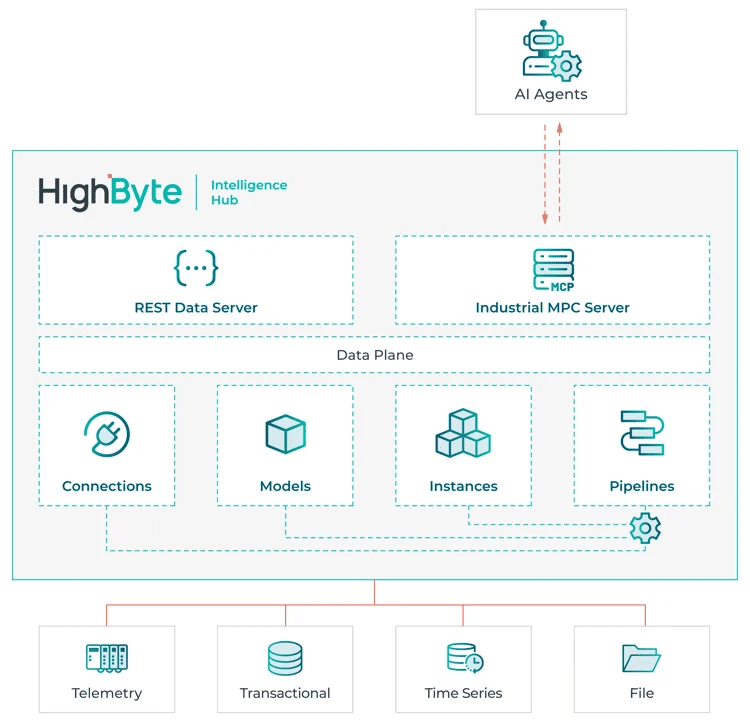
This is exactly where the Model Context Protocol (MCP) comes in. MCP defines an open protocol that allows AI applications to securely access industrial data and functions in a controlled manner. Instead of relying on proprietary APIs, AI systems operate exclusively with the resources and tools exposed by an MCP server (e.g., HighByte Intelligence Hub). This ensures that OT systems remain decoupled, while AI operations are clearly defined, limited, and fully traceable.

AI-Agent
The executing instance that uses available data and functions to process information and trigger actions.

MCP
The standardized protocol that enables secure communication between AI agents and MCP servers.
MCP Server
The controlled hub that defines which data, models, and functions are available to AI applications (e.g., HighByte Intelligence Hub).
What is the Model Context Protocol?
MCP is an open standard that defines how AI applications—such as chatbots, assistants, analytics tools, or engineering solutions—interact with external data sources, tools, and functions.
In industrial environments, this means AI can access structured data from machines, production lines, processes, and quality systems—including historical, contextualized, and modeled information.
Important: MCP defines the protocol—not the security policies.
Control over which data is available, what access rights apply (read/write) and which functions can be executed is determined by the specific configuration of the MCP server.
Once established, the connection works across different AI systems—whether ChatGPT, Claude, or proprietary models. The user interface is also irrelevant: chatbot, dashboard, or mobile app all access the same data foundation. Result: reduced vendor lock-in and greater architectural flexibility.
How MCP works (technical overview)
In industrial architectures, MCP acts as a standardized mediation layer between AI applications and OT systems.
All requests are routed through an MCP server, with communication based on JSON-RPC, a lightweight protocol for structured data exchange.
AI applications remain logically decoupled from OT systems. Within the MCP server, operators define:
- which data points or models are exposed
- how data is structured and enriched with metadata
- which operations are allowed (read, transform, query, execute tools)
- under which constraints (frequency, security rules, access limits)
This implementation enables auditable, traceable, and vendor-independent AI integrations. However, these qualities only emerge through the concrete implementation of the MCP server and the overall architecture.
Security and Governance
A properly configured MCP server ensures:
- Access control: Define which applications can access which data
- Traceability: All interactions can be logged and audited
- Data isolation: OT systems are protected from direct AI access
- Permission management: Separate read/write permissions across data domains
MCP as a foundation for AI use cases
MCP creates a unified foundation for deploying AI applications consistently across plants, systems, and data sources. Instead of building integrations locally for each use case, data models and process logic can be defined once and reused centrally.
This results in reduced integration effort, faster project delivery and scalable AI deployments.
This is especially valuable in heterogeneous environments: AI systems get a consistent, modeled view of machines, processes, and documentation—independent of underlying OT and IT systems.
Example use cases
- Query production or incident data for real-time operational support
- Harmonize quality data across sites for pattern recognition
- Automate test execution via connected build or validation systems
- Access technical documentation from internal knowledge bases
MCP with HighByte Intelligence Hub
The HighByte Intelligence Hub natively implements MCP and acts as an MCP server. It provides:
- Contextualized and harmonized OT/IT data via a central data model
- Modeled structures for machines, lines, assets, processes, and quality data
- Metadata and domain knowledge in AI-ready format
- Clear governance over which data, models, and tools are exposed
- Deployment at the edge or in the cloud—independent of location
In this video, you’ll get a concise overview of the core components of an industrial MCP server and see how MCP can be practically used as an entry point for industrial AI applications.
MCP, a key building block for secure Industrial AI
MCP provides a standardized and controlled approach to deploying AI in industrial environments.By decoupling AI applications from OT systems, it ensures transparency, clear responsibilities, and a scalable architecture across multiple sites.
Try HighByte Intelligence Hub
Test the 2-hour trial version directly on the HighByte website and experience how quickly you can connect, model, and operationalize your industrial data for AI and industrial applications.
- Reset the trial every 2 hours to continue exploring features
- Easy to test: compatible with Windows, macOS, and Linux