

OPC – The industrial communication standard
OPC (originally OLE for Process Control) is the industrial communication standard that was developed in 1995 by a group of major automation vendors to promote interoperability between their systems.
The standard was initially based on Microsoft’s then-popular COM/DCOM protocol. Over the following years, OPC evolved into the most widely used method for communication between different automation systems. Its capabilities expanded from real-time Data Access (DA) to Alarms & Events (AE) and finally to Historical Data Access (HDA).
Ultimately, these three standards were unified into a new, overarching, model-based standard that no longer relies on COM/DCOM: OPC UA – Unified Architecture.
Client/Server Technology
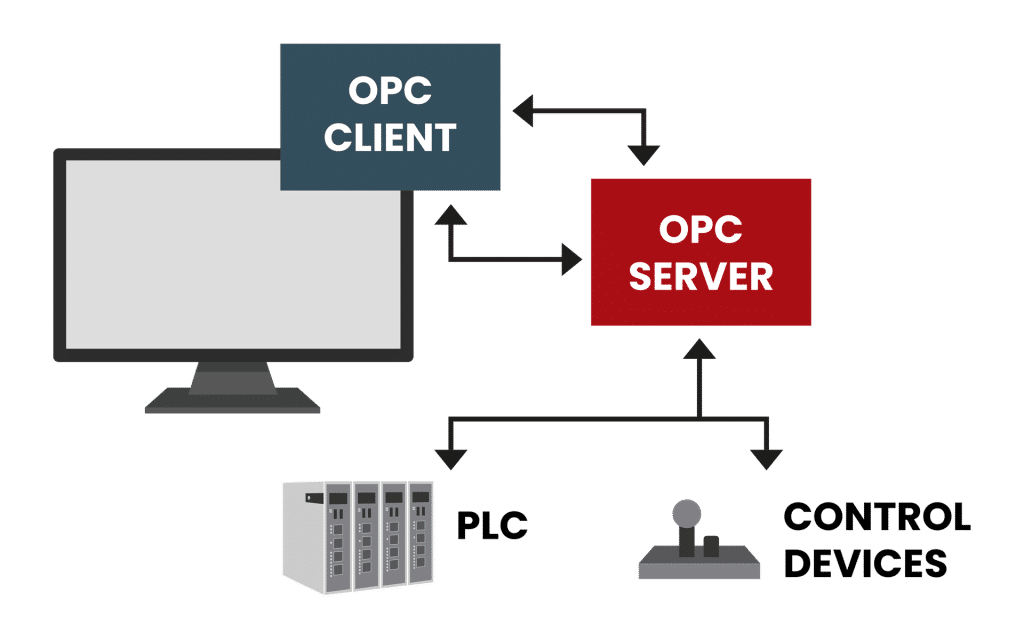
OPC operates on a client/server architecture. One or more servers wait for data requests from one or more clients. Once a server receives a request, it responds and then returns to standby mode. Clients can also instruct the server to automatically send updates as soon as new data becomes available. With OPC, the client decides when and which data the server retrieves from the underlying systems. This also applies when the client subscribes to updates: the client determines how frequently the server should check those systems.
Classic OPC vs. OPC Unified Architecture (UA)
Today, we distinguish between two different OPC standards. The classic standards are OPC DA (Data Access), OPC A&E (Alarms & Events), and OPC HDA (Historical Data Access). These standards are based on COM/DCOM and are therefore limited to Windows operating systems.
The current and modern industrial communication standard is OPC UA (Unified Architecture). OPC UA is platform-independent and no longer tied to Windows systems. Consequently, the meaning of OPC has also evolved—from “OLE for Process Control” to “Open Platform Communications.” OPC UA is based on a multipart specification comprising multiple sections, such as Data Access (DA), Alarms and Conditions (A&C), and Historical Access (HA). Another key feature of UA is its support for data structures or models. This allows data tags or points to be grouped and contextualized, greatly simplifying management and maintenance. These models can be requested at runtime, giving a client the ability to query the available data structures directly from the server.
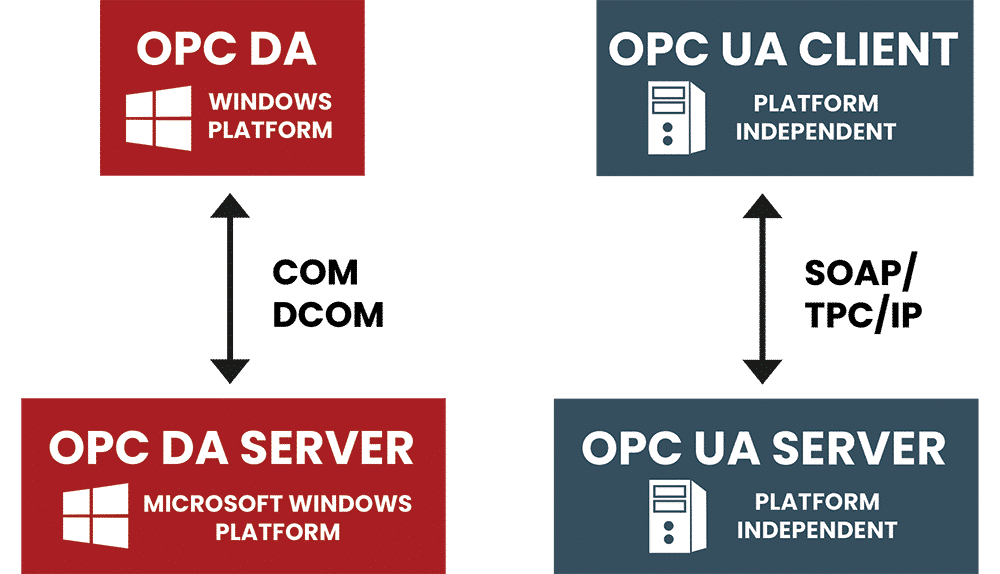
The diagram on the right illustrates the differences in communication between the various standards.
Standardized and Secure Communication for Industrial Automation
Today, OPC is the most widely adopted form of industrial communication. Seamless communication between machines, plants, and systems forms the foundation for Industry 4.0 and digital transformation.
Most plants and machines consist of both new and legacy controllers from different vendors, each with different functional and communication requirements. In some cases, new machines rely on technologies that were not available when the oldest machines were built. Additionally, older devices sometimes prevent direct integration for safety reasons. Integrating data across machines and systems of different generations is therefore a challenging task.
OPC interoperability provides the solution. Through the OPC server, you can access data from IoT platforms, IoT gateways, and sensors in a single standardized language that the entire system understands. This ensures a seamless flow of information between different devices, automation equipment, process databases, and software systems, providing users with a single source of truth for all information.