




Case Study Download
Download our case study!
DataOps for Water Utilities
Turn disconnected sensor streams, SCADA networks, and legacy historians into reliable, automated data pipelines that power real-time water management.
Water and wastewater utilities face unprecedented pressures: meeting stringent regulatory targets on leakage and environmental impact, managing ageing asset networks, and lowering energy costs across treatment and distribution networks.
While modern utilities collect millions of data points every hour from acoustic loggers, smart meters, telemetry outstations, and treatment plant sensors, extracting value remains difficult. Operational data often sits trapped in proprietary systems, suffering from quality discrepancies, manual processing delays, and fragile point-to-point integrations.
DataOps brings agile software development principles, automated pipeline orchestration, and continuous data quality assurance directly to operational technology (OT) and enterprise IT environments.
What DataOps Delivers for Water Utilities
DataOps provides a unified methodology and technical framework to automate the collection, validation, contextualisation, and delivery of water operations data.
1. Automated Pipeline Orchestration
Eliminate brittle batch jobs and manual data transfers. Ingest high-frequency telemetry from SCADA, IoT loggers, smart network sensors, and laboratory information systems through automated, repeatable pipelines that scale with network growth.
2. Real-Time Data Validation and Cleansing
Detect flatlined sensors, drift, missing telemetry packets, and calibration anomalies before flawed data reaches analytical models or operational control desks. Automated tests validate data integrity at ingestion.
3. Unified OT-IT Contextualisation
Bind raw sensor readings to spatial data (GIS), enterprise asset management (EAM) records, and hydraulic models. Sensor readings gain immediate operational context, transforming arbitrary numbers into actionable asset intelligence.
4. Continuous Compliance and Governance
Maintain full lineage and auditable version control over every metric. Ensure regulatory reporting for leakage, event duration, water quality, and environmental compliance remains consistent, verifiable, and free from manual reporting errors.
High-Impact Applications Across the Water Cycle
| Operational Area | Without DataOps | With DataOps Implementation |
| Leakage Detection & DMA Management | Delayed overnight processing; false alarms from noisy logger telemetry. | Near-real-time anomaly detection; automated validation pinpointing probable burst locations. |
| Pumping & Energy Optimisation | Static time-of-use schedules; reactive adjustments based on reservoir levels. | Dynamic tariff and demand matching; continuous integration of energy pricing with hydraulic models. |
| Pollution & Discharge Monitoring | Manual data extraction for storm overflow reporting; retrospective incident reviews. | Continuous telemetry ingestion with automated event alerting and audit-ready compliance logs. |
| Asset Health & Predictive Maintenance | Unplanned pump and valve failures; calendar-based maintenance schedules. | Automated pipeline feeding condition monitoring models, driving predictive asset intervention. |
Technical Capabilities Engineered for Utility Operations
- Multi-Protocol Connectivity: Native support for standard industrial protocols (OPC UA, MQTT, DNP3, Modbus) alongside modern REST APIs and cloud data lakes.
- Edge-to-Cloud Flexibility: Deploy data pipelines on-premises within secure OT boundaries, across private cloud environments, or in hybrid architectures.
- Automated Data Quality Gates: Set configurable threshold rules, statistical variance checks, and rate-of-change alerts to quarantine anomalous readings automatically.
- Role-Based Access and Governance: Protect critical national infrastructure with granular security policies, encrypted pipelines, and complete data provenance tracking.
- Model-Ready Outputs: Feed clean, contextualised time-series data directly into digital twins, machine learning algorithms, and operational dashboards without manual preparation.
Measurable Operational Outcomes
- Reduce Data Preparation Time by up to 70%: Free data science and operational engineering teams from repetitive cleansing tasks.
- Accelerate Incident Response Times: Identify distribution anomalies, pipe bursts, and pressure transients in minutes rather than hours.
- Improve Regulatory Confidence: Deliver consistent, auditable performance data to regulators and environmental monitoring bodies.
- Maximise Asset Lifespans: Feed high-fidelity operational data into capital delivery and maintenance planning systems.
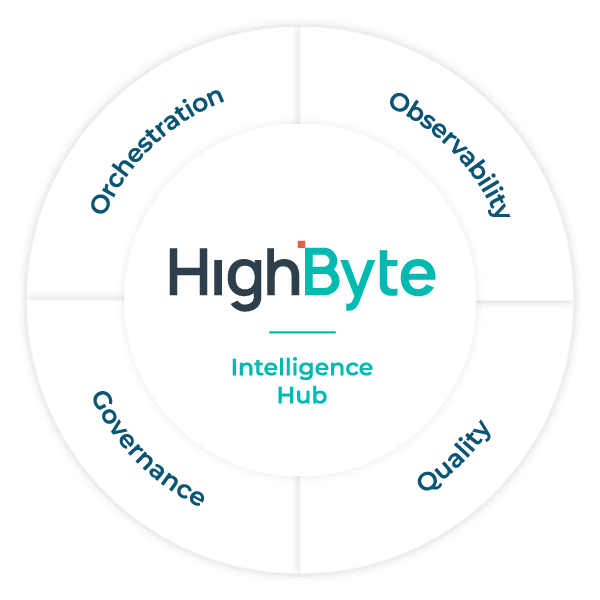
Powering Utility DataOps with HighByte Intelligence Hub
Achieving DataOps outcomes requires a dedicated Industrial DataOps solution built specifically for the realities of operational technology. HighByte Intelligence Hub provides the purpose-built software layer that water utilities need to design, normalise, and govern their OT data pipelines without complex custom coding.
Positioned securely between field devices, SCADA systems, and enterprise consumers, HighByte transforms fragmented time-series streams into structured, contextualised information models ready for operational use.
Why Water Utilities Choose HighByte
1. Codeless, Visual Data Modelling
Create standardised asset templates for pumping stations, district metered areas (DMAs), borehole sites, and wastewater treatment works. Define the model once, map the incoming tags, and instantly replicate the structure across hundreds of operational sites.
2. Native OT and IT Interoperability
HighByte bridges legacy industrial networks and modern cloud architectures effortlessly. It connects directly to industrial sources such as OPC UA, OPC DA, Modbus, and SQL databases, while outputting clean, payload-optimised data via MQTT Sparkplug B, REST APIs, and native cloud connectors for AWS, Microsoft Azure, and Snowflake.
3. Edge-First and Low-Footprint Architecture
Deploy HighByte right at the operational edge, within remote treatment facilities, or centrally on-premises within critical national infrastructure (CNI) secure zones. Its lightweight footprint ensures reliable data processing without burdening existing network bandwidth.
4. Continuous Data Quality and Transformation
Apply real-time logic, scale factors, unit conversions, and conditional triggers directly within the hub. Flag bad telemetry values, strip out invalid packet bursts, and ensure that only verified operational data reaches downstream analytics and reporting tools.
5. Architectural Flexibility for Unified Nameplate and UNS
Establish a true Unified Namespace (UNS) across the water network. HighByte standardises naming conventions and metadata hierarchies (such as ISA-95), allowing operations, engineering, and data science teams to subscribe to a single source of contextualised truth.
Accelerate Your Network Modernisation
Modern water operations require clean, dependable data pipelines that bridge the divide between field sensors and strategic decision-making.
Speak with our data architects to evaluate your existing telemetry infrastructure, identify integration bottlenecks, and build a scalable DataOps roadmap tailored to your operational requirements.