

Model Context Protocol (MCP): How to connect AI to OT systems
Process and production data are often isolated in siloes, within complex OT systems and proprietary protocols where traditional AI models lack access. So, how can you connect AI to industrial tools and data systems? The answer is Model Context Protocol, abbreviated as MCP—the standard that allows AI to use external data, APIs, and tools in a structured way.
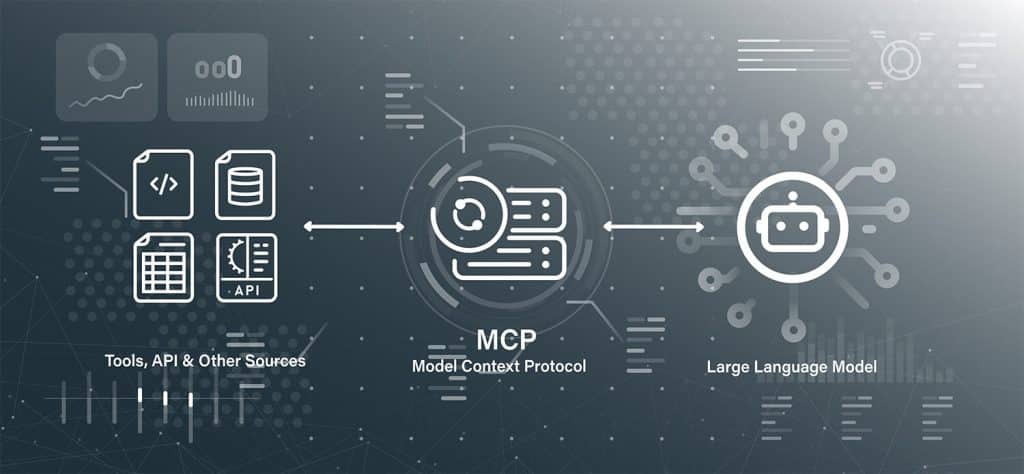
What is Model Context Protocol (MCP)?
Model Context Protocol (MCP) is an open standard that enables AI models (Large Language Models / LLMs) such as ChatGPT, Gemini, and Claude to connect securely and controllably to external data systems, tools, and industrial information sources.
MCP was introduced by Anthropic in November 2024 and began appearing in industrial environments during 2025.
In industry, this means AI models can:
- Retrieve data from OT sources
- Understand the context of production processes
- Perform actions based on real-time data
- Work with existing production data without the need for new integrations
Without MCP, AI models are limited to historical training data. With MCP, AI can utilise your actual process, production, and quality data—without altering your architecture.
How does MCP work?
MCP functions as a common language between the AI agent and your industrial systems. The standard layer consists of:
MCP Client
This is the AI tool you use, for example:
- An LLM such as ChatGPT, Gemini, Claude, etc.
- An industrial AI agent
- A development environment in OT/IT
This client knows nothing about your facility in advance.
MCP Server
An MCP server tells the MCP client what data exists, what it means, how it should be used, and what actions are permitted. For instance, it can grant the client access to:
- Process data from OPC UA
- Historical data from a Historian
- Parameters from MES
- Documentation, SOPs, datasheets
- Data Pipelines
Communication between MCP Client and MCP Server
MCP is an open standard. This means you can either build your own MCP server, use ready-made MCP integrations, or choose a platform that exposes OT data in a structured manner. Communication is conducted via a secure JSON-RPC layer that ensures standardisation, provides traceability, makes the integration repeatable, and works across different systems and vendors.
Why is MCP important for industrial AI?
- Common Interface: OT environments are complex, and process and production data reside across many different systems. MCP provides AI models with a single, common interface to access everything.
- Security and Control: Industrial AI requires access control, safeguards against unauthorised changes, and traceability. MCP allows you to control which data points the AI can see, which tools can be used, and what actions are permitted.
- Standardisation and Scaling: Many industrial companies build bespoke AI integrations that cannot be scaled. MCP makes it possible to build the integration once and reuse it across lines, factories, and locations.
- Context: AI models need context but have no inherent understanding of your data. MCP makes this context available.
MCP and HighByte Intelligence Hub: How to get started
HighByte Intelligence Hub is an industrial DataOps solution that connects OT and IT systems, preparing data for Analytics and AI.
HighByte was among the first to introduce support for Model Context Protocol (MCP) in industrial OT environments. Since its launch, the functionality has been further developed in line with the rapid advancements in AI and agent-based solutions.
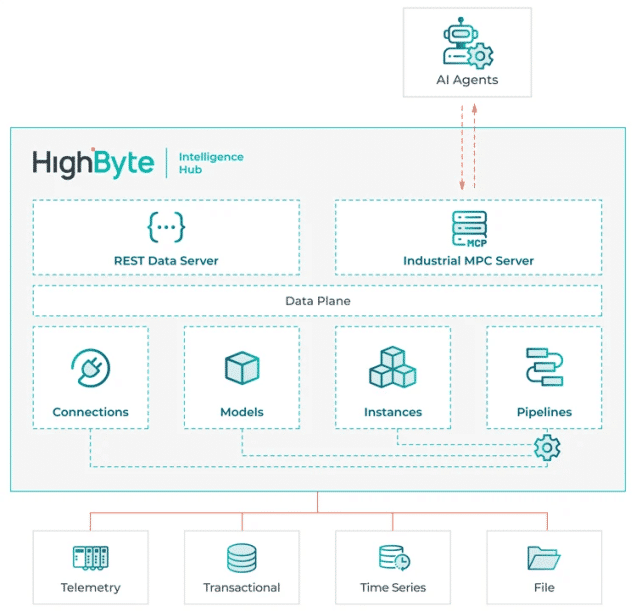
With the Intelligence Hub’s built-in MCP server, you can connect your OT environment to modern AI tools in a structured and secure manner. Here is how it is done:
- Connect HighByte Intelligence Hub to OT and IT systems HighByte Intelligence Hub connects to systems like OPC UA, Historians, SCADA, MES, sensors, and industrial APIs. Raw data is transformed into structured information directly at the source.
- Build Data Pipelines Next, Data Pipelines are constructed, which utilise modelled data and tailor it for each recipient.
- Expose Data Pipelines Data Pipelines are exposed as ‘tools’, enabling AI agents to utilise industrial data via HighByte Intelligence Hub. You maintain full control over which data the AI agents can access.
- Deploy AI You can now use an AI model (LLM) to get answers to questions like:
- ‘Retrieve the temperature trend from Line 2 for the last 8 hours’
- ‘Retrieve the reason code for the last stoppage’
- ‘Provide access to machine documentation for equipment X’
See how HighByte Intelligence Hub’s MCP Server works in practice in the video: